
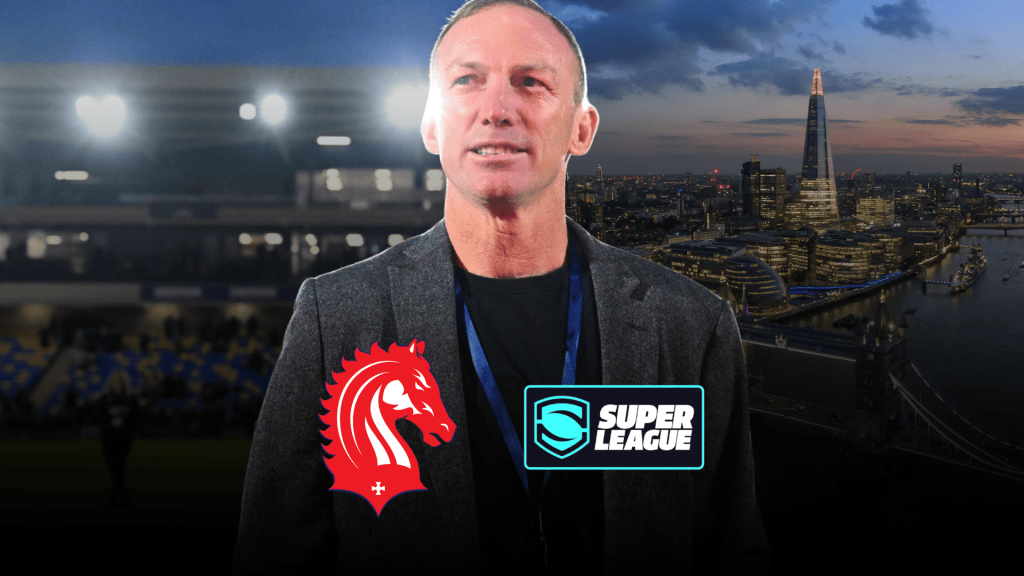
Armed with Australian investment, a record-breaking season and a potential new era for the sport, the London Broncos are back in Super League — and running out of reasons to fail.
The Rugby Football League (RFL) and Super League have confirmed that ambitious, Australian-backed London Broncos will be competing in European rugby league’s premier competition in 2027.
The announcement, made on Wednesday afternoon, saw Peter Hutton, Chair of SLE refer to the move as “an opportunity to build a lasting presence for our competition in the capital” – and he teased further announcements.
He added: “Expansion is about more than adding another club. We want a compelling, competitive Super League that reaches new audiences while continuing to serve the supporters who are at the heart of our sport.
“With more exciting announcements expected shortly around investment, broadcast deals and new commercial partners for Super League, we look forward to working with the Broncos as they prepare for 2027, and to seeing their supporters enjoy the elite competition in London once again.”
The Broncos stormed their way to a league, playoff and 1895 Cup treble in 2026, breaking numerous records along the way.
This comes following a decision, finalised just over a week earlier, to expand the competition to 15 teams, ahead of likely investment from Australia’s powerhouse domestic competition, National Rugby League (NRL), from 2028.
The 15th side was determined by a ‘consideration process’, with sides consulted based on their IMG grading — a system designed to rank clubs based on fandom, on-field performance, financial sustainability, stadium/facilities and community engagement.
Barrow Raiders, the highest-ranked non-Super League side in these rankings, opted not to put themselves forward for the newly created spot due to financial and infrastructure constraints, opening the door for the capital club’s return as the next team on the list.
This means the Super League will have a team in the UK’s largest city for just the third time in the past 13 seasons.
The Broncos last competed in the top-flight in 2024, having been promoted through the play-offs. However, they knew they would almost certainly be relegated back to the Championship before the season had even begun due to their then-low ranking in the IMG grading system, which decided league placing for the next campaign.
They had previously been relegated on points difference in 2019 after finishing level on points with Hull KR, with their fate decided on the final day of the regular season.
Alongside expansion, competition is also readying itself for a deal which would see the NRL take control of Super League and much of UK rugby league’s governance, with this reportedly worth as much as around £30 million.
Is this a surprise decision?
Absolutely not. Their historic 2026 season saw them record the biggest-ever win in professional rugby league (134-0 vs North Wales Crusaders), won the Grand Final by a record 72 points and achieved the most points (and points difference) in a single season in British history.
This was largely down to a takeover ahead of 2026, headed by Australian rugby league legend Darren Lockyer, businessman Grant Wechsel and former Leeds Rhinos CEO Gary Hetherington.
Lockyer, one of the game’s greatest-ever players in both the half back and full back positions, has an honours list as long as any other, while Hetherington’s time as CEO of the Rhinos saw the club win 18 major trophies, including those of one of the game’s greatest dynasties — spearheaded by legends such as Rob Burrow MBE and Sir Kevin Sinfield CBE. These guys have been there, done that, got the trophies in this sport.
Off the field, moving into iconic rugby union side London Irish’s former training facilities and securing a TV deal as far-off as Papua New Guinea, one of the fastest-growing rugby league markets internationally (a new PNG-based NRL franchise has even been created with influence from the Australian government, largely to ward off political influence from China), showcased their ambition.
On the field, big-name signings such as long-time Australian international Reagan Campbell-Gillard and highly-rated young half back Dean Hawkins from Parramatta Eels made their roster look Super League-ready, under head coach Jason Demetriou with experience at one of NRL’s biggest clubs, the South Sydney Rabbitohs.
However, an RFL decision to promote York Knights and Toulouse Olympique instead, in an expansion to 14 teams, meant the Broncos would have to wait for another year at least to have a shot at the top flight: a year they used to make their inclusion a no-brainer.
Ahead of 2027, England and Ireland internationals — and Super League veterans — Toby King and Joe Philbin have been signed from 2026 Grand Finalists Warrington Wolves, signings that would be unlikely to be made by a club that felt they would be remaining in the second tier.
Realistically, everyone in the rugby league world has known that London would likely be in the competition in 2027, which became little more than a formality when clubs voted to further expand it to 15 teams.
Why did the decision take so long?
That’s the question on everyone’s lips. The season is now expected to start in January rather than mid-February, but most sides started pre-season not knowing which month, or how many opponents, they were preparing for.
The decision to expand to 15 teams was only made in November, and two sides — Wigan Warriors and Castleford Tigers — reportedly abstaining due to a ‘lack of information’ shows that the process was far from ideal.
How can there be a lack of information available over a year after it was clear that a decision would have to be made on the Broncos ahead of this season?
There is an argument to be made that the talks surrounding potential NRL investment made this more tricky, but this should have been sorted months ago. And the powers-that-be Down Under have made no secret of the fact that they would have been keen to include London in the competition anyway.
It’s also tough to argue that it just wasn’t high on their to-do list when there is, at the time of writing, still no confirmed TV deal or title sponsor — pointing to wide-scale failings rather than just dropping the ball on this particular issue.
A revamped seven-team playoff structure, a convoluted ‘bye’ round structure and new rules to match the NRL were also only announced on Wednesday and Thursday morning, and these are also things that should have been sorted out earlier.
What does the future hold for the London Broncos and the Super League?
Peter V’landys, Australian rugby league’s influential powerbroker and Chairman of the Australian Rugby League Commission, confirmed in a press conference this week that a deal between the sport’s two premier competitions is close, saying: “I think this week we’ll probably announce that we’ve done a deal with Super League, and I think that’s good for Super League.
“They’re going to get a substantial investment, and we’re confident that we can take them to another level.”
In the nineties, the sport in Australia was in disarray, with the ‘Super League war’ (a Rupert Murdoch-backed battle for broadcast control in the 1990s that split the Australian game in two) spelling the start of a decline in the international game — they needed to get things in order in their own backyard.
They have done.
Now, the NRL is the world’s biggest rugby competition in any code, by revenue and attendance, and its biggest stars are amongst Australia’s most famous people, despite competing domestically with the AFL, cricket and a number of other well-supported leagues in association football, basketball and netball.
This year, they announced a record-breaking TV deal, worth the equivalent of around 2.8 billion GBP, which is the most lucrative in Australian sporting history, while the Grand Final in 2025 was the most-watched program in all of Australian television that year, reaching over six million viewers.
Indeed, it’s worth pointing out that the NRL broadcast partnership is, each year, worth over 18 times as such as the most recent one that Super League held with Sky Sports, year-on-year.
This means there is plenty of positivity about what their expertise could bring to the UK.
British rugby league has long struggled outside of the traditional ‘heartlands’ of historic Yorkshire and Lancashire, but a crowd of over 60,000 at Wembley last year for a test between England and Australia showed there is potential.
Indeed, having a club in the largest city feels necessary to take the game to that next level that V’landys speaks of. The city’s population is over nine million, close to the entire population of the historic heartlands (around 10 million), meaning the potential fanbase is huge.
It’s also a city that holds around one-fifth of the UK’s wealth — which could be key for a sport that seems to be losing more and more money — and is home to around 50,000 Australians that could be targeted by the club’s marketing strategy, since it’s a sport so deeply ingrained in the nation’s psyche.
NRL supporters in London will certainly recognise names such as that of Campbell-Gillard, and the Broncos are in a strong position to bring even more established names, particularly with the recent departure of starting half back Gairo Voro opening up a spot for a potentially big name.
Why is there so much scepticism about the club?
One could argue that rugby league in London is simply a failed experiment, and many people do just that.
The club has existed since 1980, and in its 46 years of history, has been based at no fewer than 10 grounds in Greater London — with none providing the long-term base they’ve been looking for.
Richard Branson, at the time probably the most famous businessman in the country, bought the club and even he couldn’t make it work.
They’ve never had an average attendance of as much as 6,000, they’ve never won a major honour (the closest they’ve got are a runners-up medal in each of Super League and the Challenge Cup, rugby league’s equivalent of the FA Cup, in the late nineties) and even a rebranding to ‘Harlequins RL’ couldn’t find them a strong, dedicated core of support.
A 10-year lease at the Cherry Red Records Stadium (Plough Lane), AFC Wimbledon’s ground, provides some stability, but they don’t have first-choice of dates due to their role as tenants and they have to find alternative venues in the summer, as the football club performs annual pitch maintenance.
Their solution in past years has involved games played in Ebbsfleet, Kent, over an hour’s drive from Wimbledon; it’s hard to see how this arrangement can do anything positive for the growth of a dedicated fanbase in the capital.
However, it seems that they are now looking to turn this into an opportunity within the city, with Premier League side Fulham’s Craven Cottage a venue they are targeting to play a match at in 2027.
Whether their new era under Australian ownership in an NRL-adjacent Super League will finally allow them to make inroads in the UK’s largest market, only time will tell.
However, the club finally has the long-term home, the financial investment and the operational structures in place that they’ve spent 46 years without — meaning there are no excuses left for rugby league in London if things don’t go to plan yet again.
With thanks to Craig Chisnall of The Athletic


Leave a Reply